
The announcement of the formation of the BRICS bank will have as much an impact about how the non-G7 countries manage their economies and their foreign reserves, as it does on the intellectual discourse. The development priorities and agenda which was hitherto set by western experts responding mostly to western priorities and notions will now have to compete with an intellectual tradition that is and can be very different, says Mohan Guruswamy.

'The growth drivers are mostly invisible, but the growth is undeniable at least for now,' notes Debashis Basu.

GST rate cut for real-estate, income transfer scheme, farm loan waivers execution and recapitalisation of PSU banks have the potential to boost India's growth in a few months, says Neelkanth Mishra.

While there are no definitive statistics available, the Tirupati Trust Foundation has well over 1,000 tonnes of gold.

As lobbying and counter-lobbying intensify, right now, it looks like a T20 match, discovers Tamal Bandyopadhyay.

High inflation print is the price that the Reserve Bank of India (RBI) will have to pay to nurse a fragile growth back, say economists. Wholesale Price Index-based inflation rose to a record high of 12.94 per cent in May, aided by low base effect, but also because of higher fuel and commodity prices. Retail inflation, too, surprised by rising to 6.30 per cent, while the core inflation, which is the non-food and non-fuel component, rose to an 83-month high of 6.55 per cent. These numbers are much above RBI's upper limit of 6 per cent inflation target, but there is very little that the RBI can do at this moment.

India has much to be proud of and celebrate. But there is also much that is wrong, much that looks dangerous. Employment, current account deficit, rural distress, agricultural productivity are all in deep crisis, points out Shekhar Gupta.

His about-turn in the farm laws proves that he sees everything in just one dimension: Politics. That helps sometimes. But not always, observes T C A Srinivasa-Raghavan.

'Our family philosophy is to build a bridge between India and Britain.'

The sudden exit of Yogesh Agarwal as the chairman of the Pension Fund Regulatory and Development Authority, or PFRDA, has once again brought the relationship between financial sector regulators and the finance ministry into sharp focus.

'Everybody is losing money as interest costs keep piling up.' 'Some films will wait for a theatrical release and some won't, keeping their profit and loss situation in mind.'

'When fund managers talk of being bullish for the long term, they assume strong economic growth.' 'That is what they have assumed every year, naively believing the pronouncements and promises of ministers.' 'Unfortunately, they have been wrong year after year,' observes Debashis Basu, editor, www.moneylife.in.

Ramesh Menon, the veteran journalist suggests Prime Minister Narendra Damodardas Modi what he should do if he wants to win 2024 Lok Sabha elections.

Snooping is one of the oldest peccadilloes of man, observes Ambassador M K Bhadrakumar.

'A bold, progressive step forward,' Kotak Mahindra Bank CEO Uday Kotak said of Nirmala Sitharaman's corporate tax breaks.

'Welfare schemes are not a necessary evil, they are a necessary good.'

At a time when services are rapidly digitising in India, enterprises are witnessing a rise in cases of sensitive data exposure risks and breaches.

Budget for 2022-2023 has returned to its agenda for protectionism in the name of creating a self-reliant India, points out A K Bhattacharya.

'Civil matters like loan recovery are being connected with criminal allegations, without any basis.'

Kerala will be one of those places where the line between tourism, a land, a people and their way of life will blur. It won't be tourism; it will be a visit to experience Kerala.

Little attention is paid to the management of currencies and coins in India.

In another 2-3 weeks, coronavirus will chariot India to overtake the United States. In March, Modi had exhorted the nation to celebrate India's impending success over the virus by clanging metal plates. Make no mistake, India is losing this momentous war under his captaincy, notes Ambassador M K Bhadrakumar.

No new ideas, please, we are Indian. Seventeen years into the 21st century, we are still fixated by the ideas of the 20th century.

Banks can collapse, markets can be rigged, investment instruments can become worthless overnight, auditors can fail to blow the whistle, board directors can be asleep, and regulators can be incompetent, notes T N Ninan.

Majority of respondents feel that the government in the forthcoming Budget will increase the standard deduction and give more incentives for housing loans.

Every political party loves to use the bait of loan waiver to woo the electorate. If their hearts bleed for the poor, they can always use the party funds to pay off the lenders, suggests Tamal Bandyopadhyay.

'If you were to say today that the government should appoint judges to the high courts and Supreme Court, then I think that even those few good judges that we are getting today we would not get them.'
'A strong foreign exchange reserve is the best safety net against global spillovers.'

Given the impact Covid-19 pandemic had over the world economy, analysts expect global central banks, especially the US Fed, to keep the liquidity tap open, which, in turn, is likely to keep the equity markets, especially those in the emerging markets, buoyant.
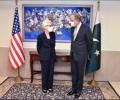
Russia and China are tight-fisted and Iran is broke and none of them has the political will or capacity to bankroll the Afghan economy, which only the US can, points out Ambassador M K Bhadrakumar.
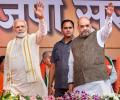
It is worth reconsidering if this fascination with either having a single party majority or Modi's leadership or, indeed, both, is such a great idea for India, says Udit Misra.

The two sides signed three agreements to boost cooperation in power, banking and insurance sectors besides deciding to step up ties in areas of oil and gas, agriculture, renewable energy and health care.

Hard and unpopular decisions are needed - not just another round of financial repackaging to sort out the discom mess.

If China's behaviour in the past on ticklish issues is any indication then China could eventually support India's NSG application, says Rup Narayan Das.

There will very little direct impact from the US Fed's rate hike this time, as we are well prepared both to handle liquidity, outflow of FII funds and managing our currency. But that doesn't mean India will be out of the woods anytime soon, says M V Subramanian.

'India missed the software products revolution (and now is in danger of missing the platform revolution), complacent that we are the software experts of the world based on IT services prowess,' points out Rajeev Srinivasan.

Shastri took the first big step to transform India's agriculture, the benefits of which his successors reaped in plenty, says A K Bhattacharya.

Ajit Balakrishnan on understanding the anti-cash chorus.

The NCLAT's order is offensive because it goes against every tenet of bankruptcy reorganisation. If Justice Sudhansu Mukhopadhyay's tenets are accepted by the Supreme Court, we will not only regress in modern bankruptcy reorganisation but also slide back in the Doing Business rankings, says Omkar Goswami.
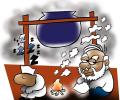
Modi government's story of five years with regard to equity allocation for PSUs shows that it may have allowed a large part of its resources to be wasted. This is also a worrying reflection of the government's inability to take hard decisions - whether they pertain to privatisation or forcing weak public-sector banks to wind down their operations, says A K Bhattacharya.
